
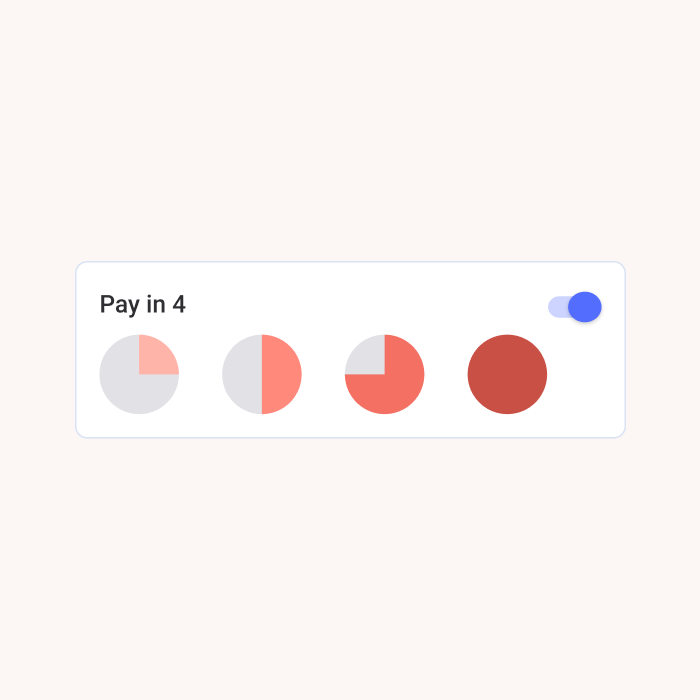
Buy Now Pay Later started as a fintech experiment. By 2026, it has become one of the most-used payment options in retail, and its expansion into healthcare, wellness, and personal services is reshaping how people pay for premium experiences. Roughly half of Americans have used a BNPL loan, and 72% say they plan to use one in 2026 (LendingTree, 2025). For salons, spas, and medspas, the question is no longer whether BNPL is here to stay. The question is what it actually does for revenue, what it does for the client, and how it affects the overall business.
This article pulls together the numbers from across the industry, with a focus on what they mean for beauty and wellness operators.
Globally, BNPL gross merchandise volume hit roughly $560 billion in 2025, a 13.7% increase year over year, with forecasters projecting around $698 billion in 2026 (Chargeflow, 2026). In the United States alone, BNPL purchase volume reached $122.3 billion in 2025, up 10.9% YoY, used by 91.5 million Americans (Capital One Shopping, 2026). That number has roughly tripled since 2021.
This is no longer a niche checkout option. BNPL now finances about 6% of U.S. e-commerce transactions, up from 2% in 2020 (Morgan Stanley via Omni, 2026). Klarna, Afterpay, Affirm, and PayPal Pay in 4 are familiar to most online shoppers. And in the U.S., healthcare-focused BNPL providers like Cherry now serve more than 60,000 medical and aesthetic practices (Cherry, 2026).
Three things are interesting about this growth for beauty operators. First, the curve is still bending up, not flattening. Second, BNPL has expanded well beyond its early footprint in fashion and electronics into services, which now includes salons, spas, and medspas at scale. Third, younger consumers are not just adopting BNPL, they are increasingly using it to choose where they spend their money, which is a trend worth paying attention to.
Why beauty and wellness fits the model
Three traits make beauty and wellness an unusually strong fit for BNPL.
The first is ticket size. McKinsey estimates the U.S. wellness category at over $500 billion in annual spend, growing at 4 to 5% per year, with 84% of U.S. consumers calling wellness a "top" or "important" priority in 2025 (McKinsey, 2025). That spending often lands in $200 to $2,000 service tickets. Salon Today notes that premium beauty and spa services regularly fall in the $100 to $350 range, with bundles between $400 and $1,000+ (Salon Today, 2024). Medspa pricing pushes higher: Cherry finances Botox sessions at $300 to $800, dermal fillers at $500 to $2,000, laser hair removal packages at $1,500 to $3,000, and CoolSculpting from $2,000 to $4,000 (Cherry, 2026).
The second is treatment cycles. Many beauty and wellness services are not one-and-done transactions. Botox repeats every three to four months. Laser hair removal is sold as a six-session package. A skincare series, a hair extension installation followed by maintenance, a body contouring program, all of these involve multiple visits over weeks or months. As Zenoti's VP of fintech products noted in a Payments Dive interview, BNPL payment cadences naturally align with these treatment courses, smoothing payments over the same window in which the client is consuming the service (Payments Dive, 2025). The match between cash flow and service consumption is intuitive in a way it is not for, say, a single retail purchase.
The third is the demographic. 46% of U.S. consumers, and 53% of Gen Z consumers, reported spending more on cosmetic procedures in 2024 than 2023 (McKinsey, 2025). Younger consumers are also the heaviest BNPL users. 52% of Americans now use BNPL, with Gen Z at 59% and Millennials at 58%, and TransUnion data puts 77% of all U.S. BNPL users in the 18 to 44 age bracket (PartnerCentric, 2025; TransUnion via DontPayFull, 2026). Nearly 40% of Gen Z use BNPL weekly or more often (Empower, 2025). Beauty's customer base and BNPL's user base are largely the same people.
What BNPL does for the business
This is where the data gets concrete, and the numbers are remarkably consistent across providers, platforms, and verticals. Adding BNPL at checkout reliably moves three metrics: average order value, conversion rate, and new customer acquisition.
Stripe undertook by far the largest study in this dataset, which ran an A/B test across more than 150,000 checkout sessions where Affirm, Afterpay, or Klarna was eligible. Half the sessions saw the BNPL option, half did not. Those that opted for BNPL resulted in a revenue lift of up to 14%, driven by both higher conversion and higher AOV. Critically, more than two-thirds of BNPL volume came from net new sales, not customers shifting from card payments (Stripe, 2024).
This finding is important because it directly addresses the most common objection to adding BNPL: the worry that it will simply cannibalize existing card volume at a higher merchant fee. The Stripe data says no, the majority of the volume is incremental.
Beauty-specific platforms report numbers in the same range, often higher because the average ticket is larger than typical e-commerce. Goldie, the salon and booking platform, reports that salons offering BNPL see roughly a 20% lift in total revenue and that BNPL clients spend approximately 40% more on bigger services (Goldie, 2025). GlossGenius reports that BNPL grows average ticket sizes by over 180% on average for its salon and spa users, and increases revenue by 20% (GlossGenius, 2025). Riverty's beauty e-commerce data shows AOV rising by approximately 16%, purchases increasing up to 15%, and returning customer rates improving around 20% (Riverty, 2026). Vagaro cites CNBC data showing BNPL can lift AOV by 30 to 50% over single-payment checkout (Vagaro, 2022).
The conversion-rate side of the story is similar. Klarna reports 30 to 35% improvement in checkout conversions on average for merchants offering its service (Conversios, 2025). Allianz Trade reports up to 40% conversion lifts (Allianz Trade, 2024). Cart abandonment drops in tandem: Shopify's Shop Pay Installments reduces abandonment by up to 28%, and 48% of BNPL users have walked away from a purchase because the option was not offered (NopCommerce, 2025).
There is a tradeoff to acknowledge. Merchant fees on BNPL are higher than standard card processing, averaging around 2.77%, with some salon-focused platforms charging 6% or more on BNPL transactions specifically (WeGetFinancing, 2026). The economic case rests on the lift in AOV and conversion outweighing the fee differential, which the data above generally supports for premium services. For a $40 haircut, BNPL is not the play. For a $1,500 laser package, the math works.
Let's get to know each other
Keep your clients coming back.

Why clients want it
The demand side of the story matters as much as the supply side. Clients are not opting into BNPL passively. They are seeking it out, and increasingly they are letting it shape where they spend money.
When asked why they use BNPL, 87% of users cite spreading out payments and 82% cite convenience (Empower, 2025). 55% of Gen Z say BNPL helps them better manage their finances. About 1 in 4 consumers say cost-of-living pressures are pushing them to use it more often (PartnerCentric, 2025). 24% of Gen Z shoppers report using BNPL specifically to avoid revolving credit card debt, compared to 9% of Gen X (Oliver Wyman, 2021). The reasoning that comes through in the consumer research is consistent: clients want to maintain cash on hand, avoid interest charges, and time their payments to their pay cycles.
The more strategically interesting finding is that BNPL has crossed from being a checkout convenience to being a merchant selection criterion. A November 2025 PYMNTS Intelligence study, drawn from a survey of 2,763 U.S. consumers, found that 62% of Millennials and 49% of Gen Z said BNPL availability influences their choice of merchant for travel. For food delivery, the figures are 44% of Millennials and 43% of Gen Z. For healthcare, 55% of Gen Z said merchant-offered installment plans influence where they seek medical or dental care (PYMNTS, 2026).
That last figure is the one to sit with for a minute. A majority of Gen Z is choosing healthcare providers based partly on whether they offer flexible payment plans. There is no reason to think aesthetics are different. A Gen Z client choosing between two medspas is materially more likely to book at the one offering installment payments. The same logic extends to laser clinics, hair salons selling package treatments, and wellness centers offering memberships.
The retention side reinforces this. 65% of Gen Z BNPL users are repeat customers of brands offering BNPL (NopCommerce, 2025). Riverty's beauty e-commerce data shows returning-customer rates rising around 20% after BNPL is introduced (Riverty, 2026). Heavy BNPL users are 41.3% more likely to recommend the service to others (Capital One Shopping, 2026).
The honest caveats
A few things are worth saying plainly before closing, because they make the rest of the analysis more credible, not less.
First, BNPL is not friction-free for the client. 41% of BNPL users paid late on at least one loan in 2024, up from 34% the prior year (LendingTree, 2025). The Federal Reserve found that the share of users making late payments climbed from 18% in 2023 to 24% in 2024. About 25% of Americans regret using BNPL at some point because of unexpected costs (The Motley Fool, 2025). Default rates remain low, around 1.8 to 2%, but the trajectory of late payments is going the wrong way.
Second, regulation is tightening. The CFPB has been moving toward classifying BNPL plans as loans, and frameworks in the EU, UK, and Australia are pushing toward clearer disclosures, affordability checks, and the same protections consumers get on credit cards (WeGetFinancing, 2026). For a beauty operator, this matters less than the underlying behavior of the model. The takeaway is that future BNPL transactions will likely include more disclosure language at checkout, which may slightly lengthen the flow but should not materially affect the conversion case.
Third, BNPL is not the right play for every transaction. The economics work when AOV is large enough that the merchant fee is offset by the conversion and ticket-size lift. For a small product purchase or a single low-cost service, the model is closer to break-even. The clearest opportunities for beauty businesses are premium services, packages, memberships, and add-ons that the client might otherwise hesitate over.
What this means for beauty operators
The headline takeaway is that BNPL has matured into a payments standard, and beauty and wellness is one of the categories with the most natural fit for it. The data points all line up in the same direction: clients spend more, complete more bookings, return more often, and increasingly choose merchants based on payment flexibility. The economic case is supported across both rigorous large-scale studies (Stripe) and beauty-specific platform data (Goldie, GlossGenius, Vagaro, Cherry, Riverty). The consumer case is even stronger, especially for the Gen Z and Millennial customer base that drives most discretionary beauty spend.
The opportunity is not to bolt BNPL onto every transaction. It is to position it intentionally at the points in the client journey where it unlocks bookings that would not otherwise happen: the laser package the client has been thinking about for six months, the membership upgrade, the bundle of injectables, the multi-session smoothing or contouring program. That is where the conversion lift is largest and the merchant fee is most easily justified.
For salons, spas, and medspas operating in 2026, BNPL is moving from optional differentiator to expected feature. The businesses that integrate it well, position it for the right services, and use it to surface their premium tier without driving sticker shock are the ones that will see the revenue lift the data describes.